
From an email:
I’m writing to pass along some information on a report released this week by D.C. Hunger Solutions called When Healthy Food is Out of Reach. The report found a wide discrepancy among the District’s neighborhoods in terms of availability of healthy food. Here are some of the key findings:
* The ratio of full-service grocery stores to residents varies widely among the District’s wards. Ward 3 has five times as many full-service grocers per capita as Ward 4.
* On average, residents of Wards 4, 5, and 7 must travel longer distances than residents in other wards to reach the closest full-service grocery store.
* The District loses more than $112 million in annual grocery revenues to neighboring jurisdictions because existing grocery retail is insufficient to meet residents’ demand.
* Some areas of the District—particularly in Wards 4, 5, 6, 7, and 8—are underserved by full-service grocery retail, compared to other areas. (The recent closure of one of Ward 5’s three full-service grocery stores has compounded the problem.)
For those that live in Wards 4, 5, 6, 7, and 8 (and all folks for that matter) do you feel that you are underserved by full-service grocery stores?
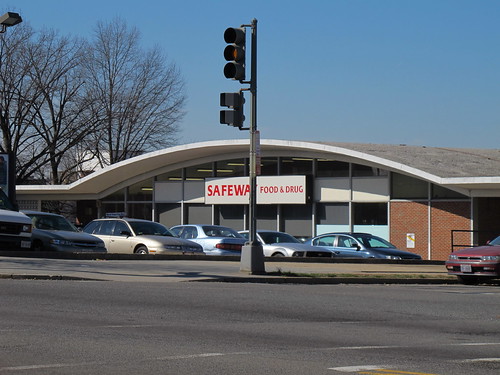
As a Ward 4 resident I am very happy with the new Yes! Organic Market at Taylor and Georgia. But when I want a “regular” grocery store I walk all the way to the Giant in Columbia Heights (with my awesome granny cart) instead of using the less than appealing Safeway at Georgia and Quincy. Hopefully I’ll have an update on the future of that store in the next week or so.
You can read the press release here: http://www.dchunger.org/press/grocery_gap.htm
And you can download the full report here: http://www.dchunger.org/pdf/grocerygap.pdf
Category: grocery stores
COMMENTS
08 February 2012 12:05 PM
COMMENTS
07 February 2012 1:29 PM
COMMENTS
08 February 2012 11:25 AM
COMMENTS
05 February 2012 3:11 PM
COMMENTS
06 February 2012 6:52 PM
I ride by almost every day, often twice a day. The renderings on the billboards at the...
Mom AND Dad? Who you kiddin
wamu almost exclusively
WXPN out of Philadelphia. There's not even a close second for music.
+1 just not getting what the hope was of posting this.
I was in Baltimore for the day and the local newspaper had a story about a new program that will allow people in underserved areas to order food online at the neighborhood libraries. The libraries will be set up to receive the food for the customers to pick up.
What is considered far to walk to a grocery store? As kids we walked at least a mile (uphill both ways through the snow. . .) at least every other day to buy half-priced day-old bread and last-day milk.
The study shows in table 7 that the farthest anyone has to go is .66 of a mile. so maybe a fund for granny carts and sneakers, but I just don’t see this as a problem.
It may not be a problem for you, but for the elderly living in underserved areas, it’s a very serious problem.
Also interesting is that on page 9, there’s a picture of a sign that says “DC WIC Accepted” – the sign on the Bestway (or used to be, not sure if it’s still there). And in the table on the previous page, it says that Bestway doesn’t accept WIC!
Also, victoria, that table does NOT say what you think it says. It says that in Ward 4 the AVERAGE distance someone has to travel to a grocery store is .66 miles, not that the MAX someone has to travel is .66 miles.
I’d be interested to see how business at the Georgia & Randolph Safeway changed when the Giant came in in Columbia Heights. I bet it got decimated. That Safeway is a joke.
I think this is BS. Ward 6 does not have a healthy food access problem. Eastern Market, Harris Teeter and Safeway all have healthy food options.
The elderly have a very nicely subsidized public transportation system to get them around. Furthermore I believe grocery delivery exists (peapod/safeway/whatever). Also local churches do this type of outreach with meals on wheels.
I think this is an interest group trying to create a problem where there is none.
How many elderly ppl can use the computer to place orders with grocery delivery stores… get a grip.I have lived in Ward Four most of my life and this is a very real problem and has always been.
In my neighborhood, it’s easier to buy a bottle of vodka than it is to buy fresh vegetables. And that’s just…not right.
The closest thing there is to a bodega is the Georgia Avenue Food Barn, which sucks, unless you’re an aficionado of canned food and insta-noodles.
We could definitely use a wider range of grocery options.
Agreed. I’m in Brookland, and we have two grocery stores (Giant and Yes Organic) but I can easily rattle off ten liquor stores within walking distance of my house.
RE: “I think this is BS. Ward 6 does not have a healthy food access problem. Eastern Market, Harris Teeter and Safeway all have healthy food options.”
Ward 6 is more than just SE Capitol Hill… I’m well over a mile from those places, and 2 miles from Teeter. But later this year, of course, we’ll have our own new full service grocer in Near NE.
But near NE has Murry’s on H Street, which counts as a full service grocery store for the purposes of this study, and this also doesn’t take into account the H Street Farmers Market, the FL Ave Market (where, despite my living fairly close to both the Safeway and the Teeter, I do a lot of shopping), the Safeway in the Hechinger Mall etc. The fallacy of this study is that it implies that people don’t/can’t cross Ward boundaries to grocery shop.
And, if you look at the Ward 6 “food desert” (which, by the way, according to this study there is only one and it’s SW not Near NE)it’s pretty much right on top of Nationals Stadium, where there’s a soon-to-be-finished-remodeling Safeway arriving within the month.
I can’t speak for the other Wards, but I do think calling Ward 6 underserved is kind of nonsense. You may not like the options you have (ie Murry’s) but you do have them.
I don’t think Murry’s is a reasonable or healthy option. If you think it is you either don’t shop there much or have eaten to much of their over processed product.
They are better than nothing, but are part of the obesity problem in the Black community in DC and other cities. My mom shopped there occasionally when I was a child.
To just say be glad with what you have if you are in the barren regions of the Ward is not cool. A better low cost store is Aldi’s.
YOU may not think Murry’s is reasonable, but this study includes it as a full service grocery. And, an Aldi’s was just announced as coming to the Hechinger Mall (in addition to the Safeway that’s already there, not as a replacement).
I’ve been to Murry’s and it’s fine. I don’t shop there b/c I live closer to Eastern Market (and the Safeway and Harris Teeter). Better than Murry’s though (as far as Near NE is concerned) is the Florida Ave. Market, where I do make regular trips, but which is not included in this study (which is another reason why I find the study misleading.)
As a Ward 5 resident I DO feel I am underserved by full-service grocery stores. I can get liquor and chinese food take-out within a 2 block walk, but I can’t get necessary grocery items without taking the Metro, bus, or getting a neighbor to drive me to the grocery store. Something is wrong with this picture. There definitely needs to be grocery stores that are more evenly distributed across the city!
I’m a Ward 6 resident and I have the same issue. I should not have to choose between Pea Pod and Zip Car to get my grocery shopping done. Luckily I can afford those options, I am sure that plenty of my neighbors cannot.
Murry’s is not part of the solution to anything. That place is a nightmare.
So true!
I agree with AP. As a Ward 5 resident, there is a lack of decent grocery stores. They are redoing the Giant at RI ave metro and thats nice but thats basically all there is. I go up to Takoma for their really good farmers market. Has anyone been to the ward 5 farmers market near Gallaudet University?
You have to wonder at some point – does the city need to make businesses enter markets/areas that they don’t deem profitable/suitable for whatever reason? It’s a bit of a chicken/egg situation; if businesses make more/easier money off soda, chips & hot dogs than they would off fresh produce in a certain neighborhood then why would they not continue to do so? I think it’s certainly the city’s job to educate folks about healthy eating, but how does the city compel/force a business to operate in a neighborhood [or carry products] that simply isn’t/aren’t as profitable for them? Are large tax/land giveaways to supermarkets a good idea and how do we compel them to carry more healthy foods as opposed to doritos and rock creek soda [which they would probably make more money from in most of these undeserved areas].
I would love to see more temporary produce stands on the street. In NYC, people would just set up folding tables and sell their produce right on the street corner. Little to know overhead and you could pick up fresh vegetables. There were also more organized groups that would do this too. Not exactly a full on farmer’s market but a few stands that sold various items.
In Harlem, (which is one of the worst areas health wise in the city) there were produce stands and even just strictly very small produce stores every few blocks.
I don’t think it has to be about forcing Bodegas to carry fresh produce or needing giant supermarkets…
Don’t know if it would work here because there may not be enough foot traffic.
smaller stores
Grocery stores deliver for $5/more… it wont work for the underprivileged and food stamp recipients… but for the average reader of PoP, delivery can work out quite nicely.
The reason why there are more liquor stores than grocery stores is that the city is full of alcoholics and singles are too available and inexpensive, not because there aren’t enough grocery stores.
Are we going to require that every person on a limited income in this city is required to live within 5 blocks of a grocery store? How would you ever implement that? How would it every be profitable? In order to make the groceries at one of these local places profitable you’d have to charge 400% markup and you’d still have rotten food all the time. The cost of a cab ride, delivery, or public transportation is a much more sustainable model.
This is an “issue group” issue, not an actionable community issue.
I am in Ward 6, and the Eastern Market areas is the exception. There is only one grocery store near me (.6 miles away, and while I don’t mind, I do see a lot of elderly people struggling. More importantly, the supply of fresh food is terrible–there is maybe 1 day a week when you can find vegetables that aren’t rubbery and nasty. That Safeway is being renovated, but I am skeptical about what changes in supply will be made.
I love my neighborhood, but Its amazing how much my own diet has changed since I moved out of NW (I have no car to shop elsewhere)–so it doesn’t surprise me to hear that this is hurting residents without means.
Get on the bus/train and stop being a “victim” of your area.
Good advice, but that also perpetuates the status quo like when I leave ward 4 to occasionally shop at one of the many ward 3 stores for something I can’t get at my local Safeway.
Lee – I totally understand. I live right by Kennedy and 5th and there is nothing there for food. But there is also no metro stop, like there is in CH. I know it sucks, but you can have great stuff everywhere. Plus, like others have said, Yes is very good and reasonably priced.
Except that milk there is $7 a gallon, and they don’t carry blueberry muffins…just saying. They need to have a couple of price point options like Whole Foods, who carry non-organic milk for a very competitive $2.99 per gallon. Also, what is up with Whole Foods on P and the Stinky Safeway in Petworth not carrying artichokes? Rampant discrimination! And yet they usually have artichokes at the Sovet Safeway on 17th. Weird.
Underserved? Sounds very socialist to me. It’s not that these areas are “underserved” it’s that they are “underpurchasing” at the facilities that they do have. Why would you think that a grocery store would open in an area where they are not going to return healthy profits?
It really is amazing how many people on here want businesses to lose money. You wouldn’t go to work if they didn’t pay you. Don’t expect stores to open with the expectation of not making money.
The bottom line is simple and obvious – It sucks to be poor. Common sense. There is a value to having more money. It’s an epiphany for some people, but it’s one you need to make now.
People with less money cannot buy as many things. Bam!
They “underpurchase at the facilities they do have” because those facilities suck balls and are ignored by the companies that run them.
We’re not talking about flat screen TVs and designer stuff here, we’re talking about BASICS. If you think that the correlation between urban poverty and obesity and other health factors has nothing to do with food security then you are delusional.
Data shows that basic groceries are CHEAPER in HIGHER INCOME areas. Does that make any sense whatsoever? Poor people are left with shitty stores, crappy unhealthy products, and higher prices. That is a problem and a huge part of the poverty trap many people are in.
“If you think that the correlation between urban poverty and obesity and other health factors has nothing to do with food security then you are delusional.”
And where do you come up with that delusion? Where is it even hinted at?!
Of course there is a correlation. Don’t make up stuff to insert into somebody’s comments that isn’t there. Sheesh.
That food costs less in higher income areas makes perfect sense. In higher income areas the stores have to compete for customers. Not so in the markets that nobody wants.
Do I really need to explain basic economics to you? It’s rhetorical. The answer is obvious.
Yes, again, it sucks to be poor. Common sense.
Go to the rich areas, no one is stopping anyone. More excuses, it’s getting old.
you missed that part about losing tax revenue. to those of us here in the district, that is important.
Go to rich areas in the district. Tax problem solved.
yeah, look at a map and think about that for a bit, okay?
Not to be obtuse, but what do you mean?
the nativity of your response is troubling.
you should try and learn more before you talk. your common sense doesnt cut it.
its not socialist to want more.
“underpurchasing”? how do you know? and is there a magic button that is pressed as soon as a certain dollar amount is spent? no, you moron there isn’t. in this city people have had to demand grocery stores? why? because all of the major stores abandoned the city in the 60′s. so yes, there was a food desert all over the wards. demanding more got all these new grocery stores happening. and they do profit.
no one wants a store to lose money. you sound silly to suggest that.
if you really think that food politics aren’t at play, and that grocery availability is simple supply and demand, you need to stop watching tv.
the notion that stores immediately understand and respond to demand is ignorant.
Well at least I know what a nativity is.
More mangers, less need for grocery stores? Is that what you suggesting. More fresh produce from home gardens – I’m all for it.
Yeah, yeah, but you’re calling me a moron.
Of course, it’s not socialist to want more, but it is to expect things to be distributed based on population and not market forces.
Food politics. LOL.
In my mind, the grocery chain brings together market data and makes a decision of where to install a new store based on their perception of profitability. (Here’s that underpurchasing bit.)
On the other hand a lot of people seem to think that the grocery stores get together and try to avoid selling to black people. That’s nonsensical.
It’s not simple supply and demand. Nope. It’s supply and wanting to utilize that supply for the greatest profits.
“the notion that stores immediately understand and respond to demand is ignorant.” Again, more of this making up an argument and inserting it into somebody’s comments.
I love PoP because I can get information of the things that are happening in the area while at the same time laughing at leftists.
(food politics? Still laughing…)
Ok, I need to go outside and check on the chickens in my nativity…
Well at least I know what a nativity is.
More mangers, less need for grocery stores? Is that what you suggesting. More fresh produce from home gardens – I’m all for it.
Yeah, yeah, but you’re calling me a moron.
Of course, it’s not socialist to want more, but it is to expect things to be distributed based on population and not market forces.
Food politics. LOL.
In my mind, the grocery chain brings together market data and makes a decision of where to install a new store based on their perception of profitability. (Here’s that underpurchasing bit.)
On the other hand a lot of people seem to think that the grocery stores get together and try to avoid selling to black people. That’s nonsensical.
It’s not simple supply and demand. Nope. It’s supply and wanting to utilize that supply for the greatest profits.
“the notion that stores immediately understand and respond to demand is ignorant.” Again, more of this making up an argument and inserting it into somebody’s comments.
I love PoP because I can get information of the things that are happening in the area while at the same time laughing at leftists.
(food politics? Still laughing…)
Well, I have to go check on the chickens in my nativity…
okay. you rightly and sufficiently beat me down for my poor editing.
have a nice christmas.
why would the grocery lose money? the giant in columbia heights is always packed. i think the neighborhood could use another one. everyone needs food. its not a losing business.
I’d argue that there’s not just a problem with areas being underserved by full-service grocery stores with healthy options, but also with the choices that shoppers make. A friend lives near the Safeway on RI Ave that recently closed down. Right before the closing, the whole store was on sale, plus an extra 30% off. Which aisles were bare? The ones with chips, cookies, candy, and soda. But there were plenty of canned vegetables, pasta, and reasonably healthy choices still on the shelves. So it’s not just about access.
I live at the far western point of Crestwood. I am a city guy, so it is like a rural retreat over here on Colo. Ave. It is very far from groceries. Sometimes I walk west across the park for Ward 3′s commercial amenities.
From a societal standpoint, this is a tempest in a teapot. Most of Ward 4 is upscale residential, and zoned to keep it that way. For better or worse, we are commercial-free by design. Let’s say the council and Whole Foods got together, re-zoned a spot, and planned a store along 16th Street in Crestwood. The result would be all-out Nuclear War.
I always say, “Everybody walks in Crestwood, but nobody walks anywhere.” (‘Cept me.) They WANT to drive over to Brightwood or Tenleytown for groceries.
Some people aren’t going to be happy with any option that requires more effort on their part than being wet nursed. Sheesh.
mill your own flour, do you?
A bit off the thread, but I for one have no to minimal problems with the Ga Ave Safeway (at Randolph). The produce lady is extremely nice to me and my kids and I can always find something that is fresh and good looking. You have to be flexible with your desires. My main complaint is I like decent-to-really good bread and they just don’t sell that. Luckily, I walk/bike past Giant most days and can pop in for a loaf of pretty good bread. Also, the kids like to look at the lobsters.
WHAT? I would never buy produce or meat in that place, disgusting! The whole store smells of dirty people and the produce is nasty. People shouldn’t have to “be flexible with {their} desires” when it comes to produce.
Also, the sales at the stores in rich neighborhoods are always better, that is simply not right. We live in District 4 but only ever shop at Yes Market. For non-organic items we shop elsewhere in the city. Why should poor people have to take the bus and spend possibly 1-2 hours in commute alone to get healthy food?
I live in Ward 8, Congress Heights, about five blocks from what I believe is the only grocery store in the ward. My housemates and I are all young and able-bodied, so the distance is perfect for us. However…
1) Lots of our neighbors are elderly and/or have limited mobility for other reasons. For these people, five blocks is a struggle.
2) There are buses that run to the store from other parts of the ward, but it sucks to do that if you have a ton of groceries, or if you have to bring your kids shopping with you, etc. That’s not even counting snowy days when the buses don’t run at all, or holidays when bus service is minimal. I’d really hate to be carless in Anacostia or Barry Farms or one of the other parts of Ward 8 that’s far from me by foot and rely on getting to the Giant by bus.
3) Our Giant only opened two years ago, I think. This area had nothing but convenience stores for a long-ass time before. Don’t even try to tell me that it’s because Ward 8 residents don’t want anything besides junk food and liquor–there are systematic issues here that run much deeper than that.
I’m all for personal responsibility, but I agree that’s it’s incredibly naive to think liquor stores and fast food restaurants came to low-income neighborhoods after residents became alcholic and obese. That’s ignoring the most basic marketing principles, as well as McDonald’s own admission that they target the African-American demographic.
The problem with the supply and demand argument for many of us is that supply has begun to lag behind demand in many areas of the city.
As areas such as Petworth and H St/Near NE continue to develop the demand for high quality grocery stores is increasing much faster than supply.
I’m surprised no one has mentioned the lack of space or the onerous zoning laws and red tape any new large retail establishment has to put up with, especially in areas that are largely residential…which are the areas people seem to want more grocery stores. I think alot of the problems lead straight back to city hall and ought to be taken up with your councilmember.
Does anyone have information on the renovation of the Georgia Ave Safeway? I’ve heard it is being completely redone.
These statistics are not just based on NW or Cap Hill, I imagine:
Ward 8 got its first major grocery storein 2007 in more than a decade:
http://www.washingtonpost.com/wp-dyn/content/article/2007/11/30/AR2007113002617.html
For perspective: there is not a single chain grocery store within the city limits of Detroit. It’s not an urban myth:
http://money.cnn.com/2009/07/22/smallbusiness/detroit_grocery_stores.smb/index.htm
This urban studies (long graduated) student can tell you: retail growth does not lead, it follows. It follows “wealth.” The Safeway on Georgia Ave. will likely get renovated, because the neighborhood is becoming more wealthy. Yes! (where nothing is cheap/and I shop all the time) is just an early “follower.”
There is nothing to argue about; these are just facts. And at the end of the day, most of survive just fine, sans artichokes.
PS: It’s not just an urban problem. The rural poor have the same issue. Most of us grew up in “suburban” places…. but there are “food deserts” on either side of the spectrum:
http://www.msnbc.msn.com/id/5353901/
It is a shameful corporation that needs to be boycotted – particularly on Georgia Ave. and Randolph! SHAME!
Why?
They redline.
Meaning what? Please explain or shut up. They’re a grocery store, not a bank. Redlining is excluding people from buying property based on race. Don’t diminish a real and awful practice with – whatever your agenda is. (I have no clue.)
First, perhaps you could be a bit politer? If PoP tells me to shut up, I will be grumpy, but I’ll shut up. Anyone else on here is just another poster and can scroll past if they want.
Have you been in that store? And in stores in other neighborhoods?
As a corporate policy, they do less in poorer/blacker neighborhoods. No, they would never admit it, but it’s easy enough to see.
I remember a meeting a number of years ago where we asked Safeway’s corporate representatives when they would fix the freezers in that store, when they would start carrying milk that wasn’t at or past its pull date, when they would start carrying produce that wasn’t almost rotted, when they would carry bread that wasn’t already molding, when they would fix the lights in their rear parking lot, when they would clean the property… you get the idea. And the response was, “You people don’t appreciate what you have. It’s not worth putting money into this neighborhood.”
Funny how the place SLIGHTLY improved as the neighborhood’s complexion began to lighten. Still, it’s not a good store, or a clean store, or a decent neighbor in any way. And yes, it is obvious when you observe their pattern of behavior, Safeway determines quality of store, service, and product with the racial and economic makeup of the neighborhood in mind. Poor, or black, or a neighborhood with fewer cars – you’ll get poor service in dirty stores with bad food. Rich, or white, or a neighborhood with the ability to go elsewhere for food – you’ll get better service in a cleaner store with fresher food.
A simple wikipedia search offered some interesting insight:
“Studies suggest that 21 of America’s largest cities are experiencing an ‘urban grocery gap’ that is characterized by fewer stores and less square footage per store.[2] The poorest neighborhoods typically have about 55% of the grocery square footage of the best-off neighborhoods.[1]”
“Grocery stores typically have only 1-2% profit margins[6], so the difficulties involved in running an urban supermarket are often seen as too costly in an already-risky business.”
“Urban stores in low-income neighborhoods generally have less demand for the profitable luxury goods that are more popular in suburban stores.[5] Also, people who shop with food stamps usually buy fewer nonperishable items like toiletries and impulse items, the things that bring stores their highest profits.[7]”
“Prejudices have biased marketing research and prevented supermarkets from seeing the potential of urban locations. National marketing firms have provided grocery store executives with statistics derived from flawed modeling techniques.”
There’s lots more helpful info. Why not take a look?
(http://en.wikipedia.org/wiki/Supermarket_shortage)